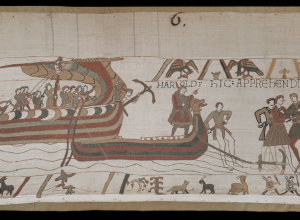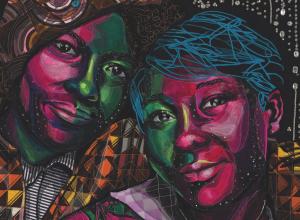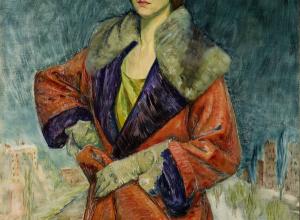
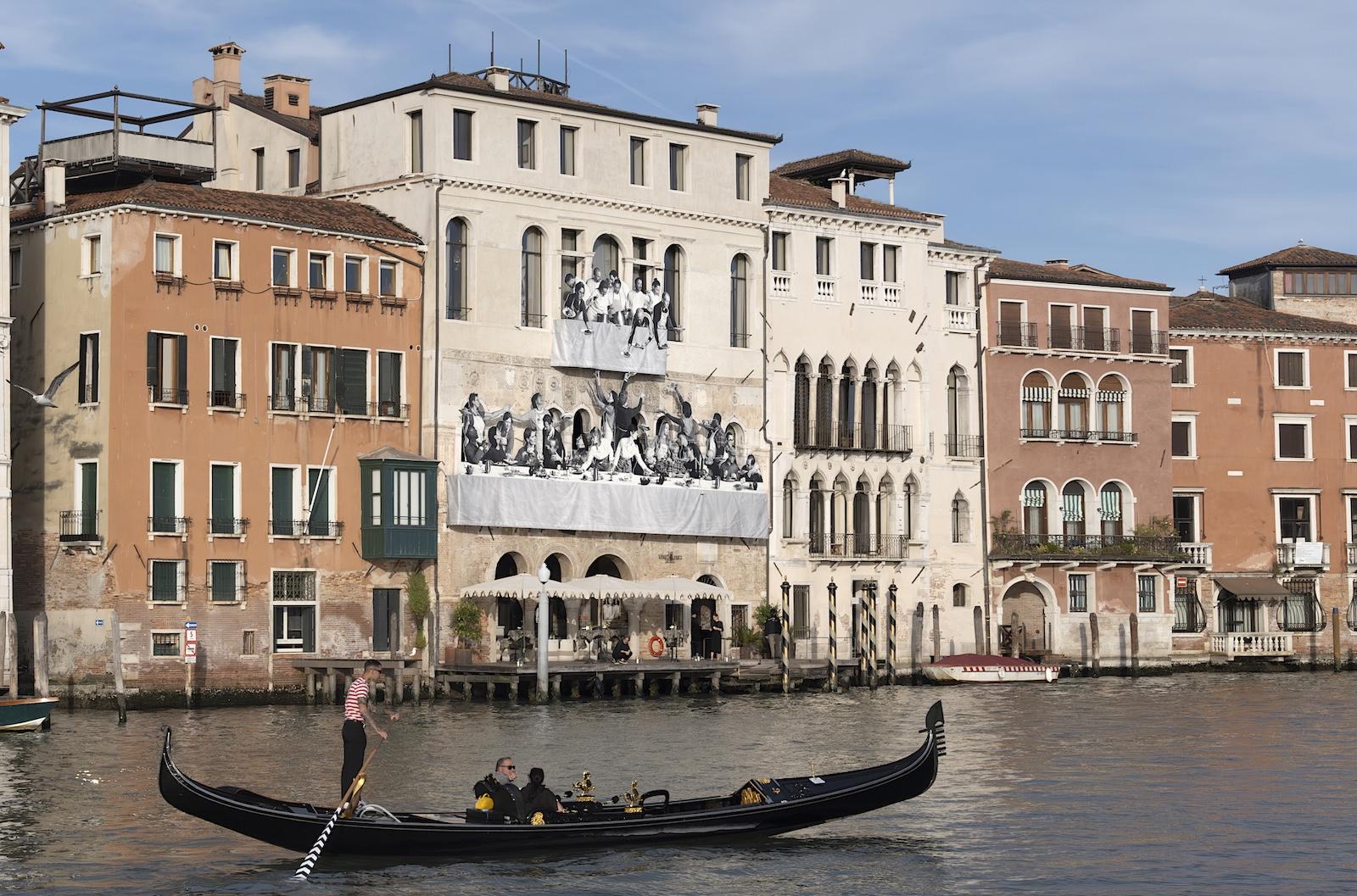
JR, Il Gesto, A contemporary reinterpretation of The Wedding at Cana, created for Palazzo Ca’ da Mosto, The Venice Venice Hotel.
Venice is a city of many wonders, and when the International Art Exhibition of La Biennale di Venezia opens in the Floating City every two years, those wonders are multiplied exponentially. The 61st International Art Exhibition of La Biennale di Venezia—“In Minor Keys” by Artistic Director Koyo Kouoh—is no exception.
Running through November 22, 2026 at the Giardini, the Arsenale, and in various locations around Venice, the Biennale features 110 invited artists, collaborative duos, collectives, and artist-led organizations in the main exhibition (realized by Kouoh’s team after her premature passing in May 2025). 100 National Participations are also being hosted in the historic pavilions spread across the city, along with 31 Collateral Events and countless independent projects.
Art & Object spent nine days in Venice, hopping on and off vaporettos, crossing bridges, and walking down narrow streets and passageways to find the best exhibitions to share with those who might be planning a visit or are simply curious about the state of the arts—a state, as Kouoh envisioned, that shifts away from the high-decibel noise, speed, and corporate productivity of the modern world to create space for deep listening and quieter forms of expression.
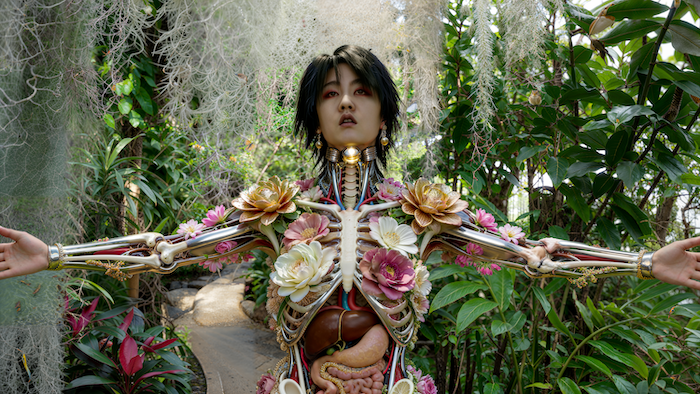
A pioneering Chinese new media artist, Lu Yang is widely known for producing immersive, morphing digital worlds that merge technology, biology, and spirituality. For this exhibition, the Shanghai- and Tokyo-based artist has developed an installation featuring original sculptures and a video piece focused on his new film, DOKU The Illusion. This is the fourth installment in his DOKU series, illustrating the solitary journeys of his versatile avatar—a nonbinary, post-human digital reincarnation of the artist. A cinematic road movie blending live-action footage with AI-generated visuals, it challenges the lines between waking reality and dreams, enabling Yang to go beyond the physical constraints of the biological body and delve into the fluid realms of consciousness, identity, and existence.
Image: Lu Yang, DOKU THE ILLUSION, 2026. Video installation, color, sound.
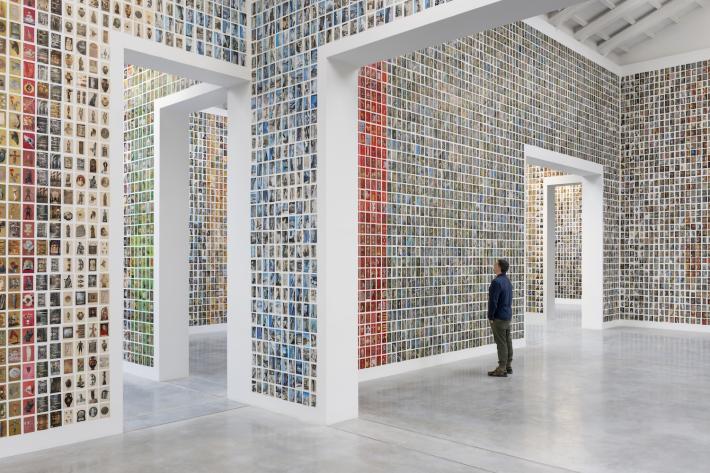
A Spanish conceptual artist, Oriol Vilanova investigates the construction of history by obsessively collecting and recontextualizing cultural artifacts. His Los restos (The remains) exhibition offers an immersive environment built from the Brussels-based artist’s ongoing 20-year collection of postcards gathered from flea markets and vernacular shops. Installed as a non-hierarchical display, organized by subjects and colors, it becomes a shifting constellation of fragments that fill the pavilion with images, presenting an archaeology of memory drawn from 50,000 postcards and raising questions about which images are preserved and which are discarded.
Image: Installation view, Oriol Vilanova, Los restos, Spanish Pavilion at Venice Biennale 2026.
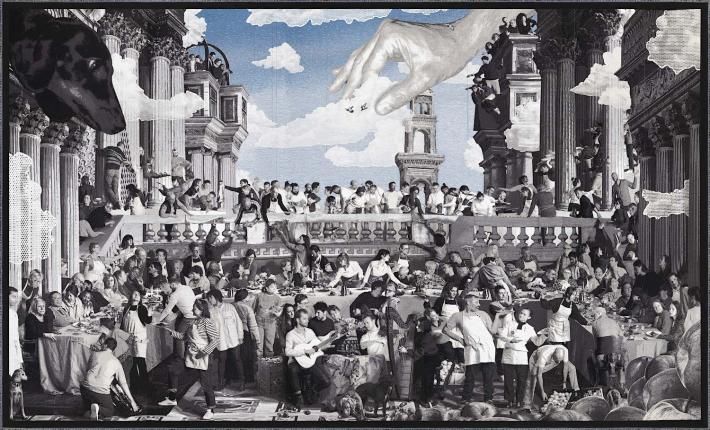
JR, a celebrated French photographer and street artist, is known for large black-and-white photographic installations in public spaces. He combines photography and graffiti to highlight overlooked communities and transform familiar sights. His exhibition Il Gesto (The Gesture) offers a striking reinterpretation of Paolo Veronese’s 16th-century masterpiece The Wedding at Cana, once housed in Venice’s San Giorgio Monastery and now part of the Louvre’s extensive collection. His façade installation, along with his large tapestry and wall pastings, features chefs, guests, and volunteers from Refettorio Paris—a solidarity restaurant and cultural project by artist and chef Massimo Bottura that turns surplus ingredients into free gourmet meals for those in need.
Image: JR, Il Gesto, A contemporary reinterpretation of The Wedding at Cana, 2026. Tapestry.
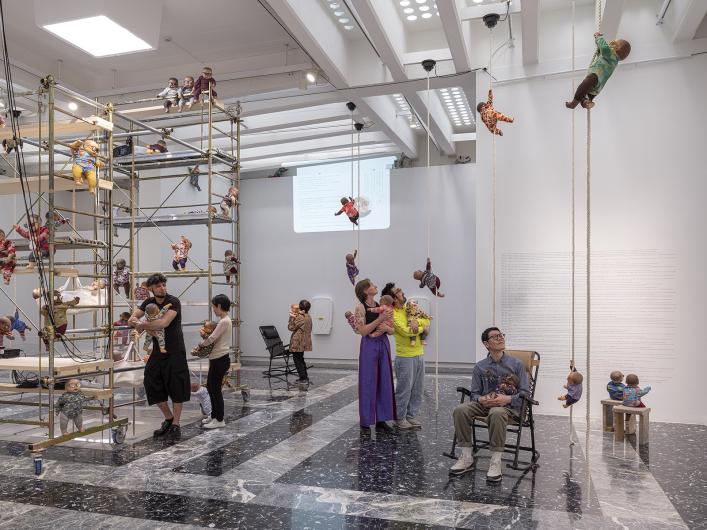
Known for collaborative, improvisational works that challenge traditional boundaries among artists, audience members, and objects, Ei Arakawa-Nash is a Japanese-American performance artist and the first non-Japanese national to represent the country in a solo presentation at the Venice Biennale. In the exhibition Grass Babies, Moon Babies, 208 baby dolls allow visitors to immerse themselves in acts of care and movement, inspired by the queer artist's experience of becoming a parent to twins in 2024. Visitors are invited to hold and carry a baby doll through its gardens and interior spaces—exploring themes of parenthood, surrogacy, and the structural nature of care.
Image: Installation view, Ei Arakawa-Nash, Grass Babies, Moon Babies, Japan Pavilion.
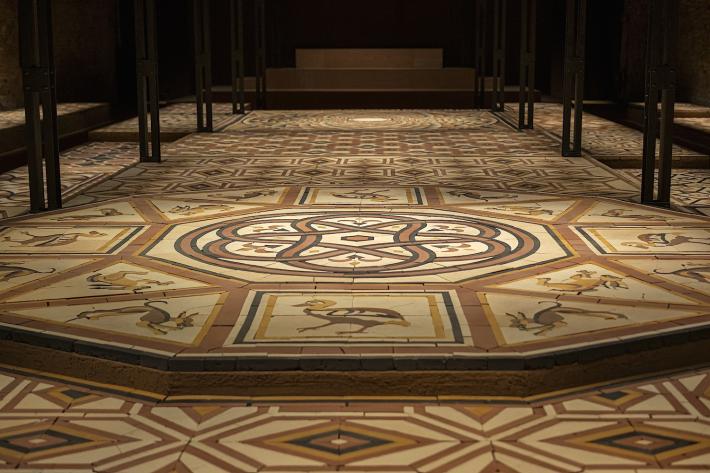
A prominent Palestinian-Saudi artist, Dana Awartani reimagines traditional Islamic art and Middle Eastern crafts through a contemporary lens. Recognized for work that connects ancient techniques to contemporary issues, such as cultural preservation, healing, and sustainability, she uses geometric patterns to convey universal truths and spiritual unity. Created in collaboration with 32 Saudi-based master artisans and featuring more than 29,000 handmade, sun-baked clay bricks, her exhibition May your tears never dry, you who weep over stones, curated by Art Jameel director Antonia Carver, addresses the destruction of heritage sites across the Arab world. The installation covers the entire pavilion floor, featuring mosaic references from Syria, Lebanon, and Palestine. These shared motifs and traditions underscore cultures that have endured for approximately three thousand years.
Image: Installation view, Dana Awartani, May your tears never dry, you who weep over stones, the National Pavilion of Saudi Arabia.
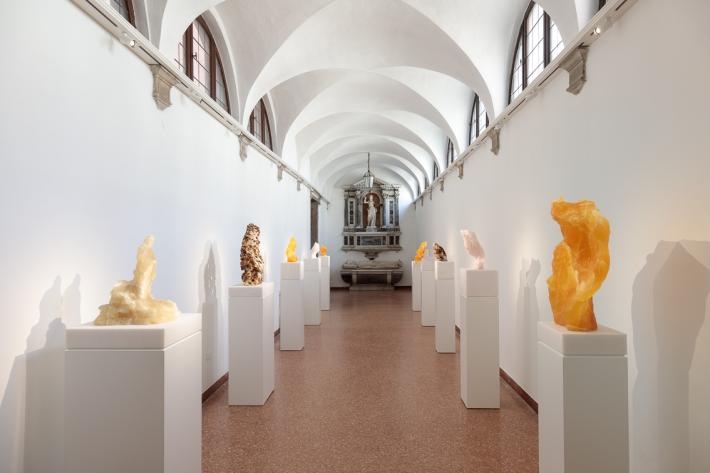
Barry X Ball is an American sculptor celebrated for combining advanced digital techniques with traditional stone carving. His art reinterprets historic masterpieces and produces highly detailed modern portraits using rare and semi-precious stones. Deconstructing historical works, he analyzes their forms through 3D scanning before digitally altering them to create something entirely new. At the Basilica of San Giorgio Maggiore—famously designed by Andrea Palladio and built between 1566 and 1610—The Shape of Time presents 23 sculptures, each showcased in carefully selected locations within the magnificent church. The show dazzles in a sublime, contemplative way; it ranges from intimate works in his Medardo Rosso series and monumental sculptures like Saint Bartholomew Flayed and Pietà, inspired by Michelangelo’s unfinished Pietà Rondanini, to his silver and gold portrait of Pope John Paul II, realized after 12 years of meticulous labor and a collaboration with Italian jewelers Damiani.
Image: Installation view, Barry X Ball, The Shape of Time, Basilica di San Giorgio Maggiore.
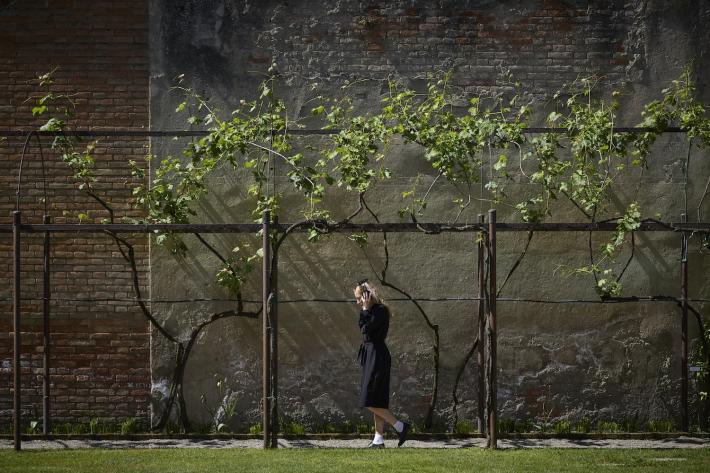
Inspired by the life and legacy of Hildegard of Bingen, The ear is the eye of the soul, curated by Hans Ulrich Obrist and Ben Vickers, invites visitors to a contemplative act of listening. The pavilion responds to Koyo Kouoh’s curatorial request to slow down and tune into quieter frequencies, both as a practice and an offering. In the Giardino Mistico, listening is the central act. It features a collection of new works by contemporary composers, musicians, poets, and artists, including Patti Smith, Brian Eno, Precious Okoyomon, and Soundwalk Collective—who collaborated with the curators to create the sonic prayer. The pieces draw inspiration from Hildegard’s chants, writings, and visionary images, responding through voice, instruments, and, at times, silence.
Image: Installation view, The Ear is the Eye of the Soul, curated by Hans Ulrich Obrist & Ben Vickers, The Pavilion of the Holy See, Giardino Mistico, Venice.
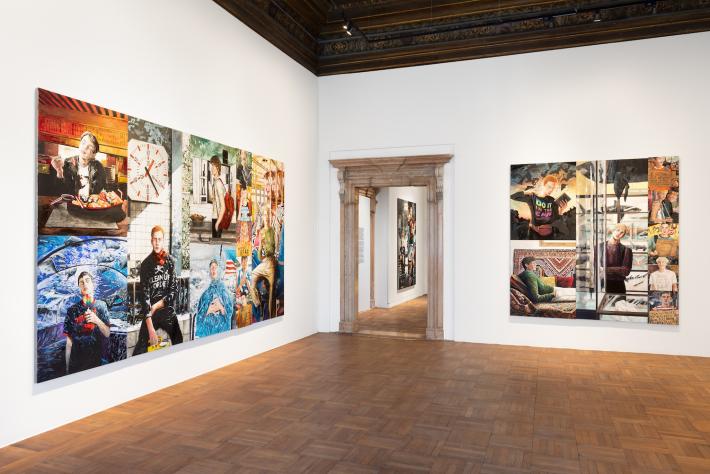
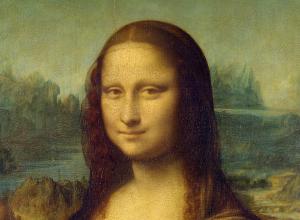
An American artist of Cuban heritage, Hernan Bas is known for his theatrical paintings of androgynous young male figures inhabiting dreamlike scenes rich with literary, mythological, and supernatural elements. His works often depict young men on the verge of leaving youth behind, exploring themes of identity, desire, and sexual awakening from a queer perspective. Inspired by Venice, a city shaped by tourism, and by his recent residency, Bas created 30 new paintings for The Visitors, depicting tourists in imagined and real settings. These mainly white, Western men explore iconic attractions, landmarks, sacred sites, shady venues, and natural scenes. Bas stresses the disconnect between tourists and their destinations by highlighting the absurdity of clichéd icons like the Mona Lisa or Trevi Fountain, dark tourism sites like Chernobyl or Alcatraz, and tourist traps meant to deceive or disappoint.
Image: Installation view, Hernan Bas: The Visitors, Ca’ Pesaro – International Gallery of Modern Art, Venice.
Paul Laster
Paul Laster is a writer, editor, curator, advisor, artist, and lecturer. New York Desk Editor for ArtAsiaPacific, Laster is also a Contributing Editor at Raw Vision and Whitehot Magazine of Contemporary Art and a contributing writer for Art & Object, Galerie, Artforum, Artsy, Ocula, Family Style, Sculpture, and Conceptual Fine Arts. Formerly the Founding Editor of Artkrush, he began The Daily Beast’s art section and was Art Editor at Russell Simmons’ OneWorld Magazine. Laster has also been a Curatorial Advisor for Intersect Art & Design and Unique Design, as well as an Adjunct Curator at P.S.1 Contemporary Art Center, now MoMA PS1.