

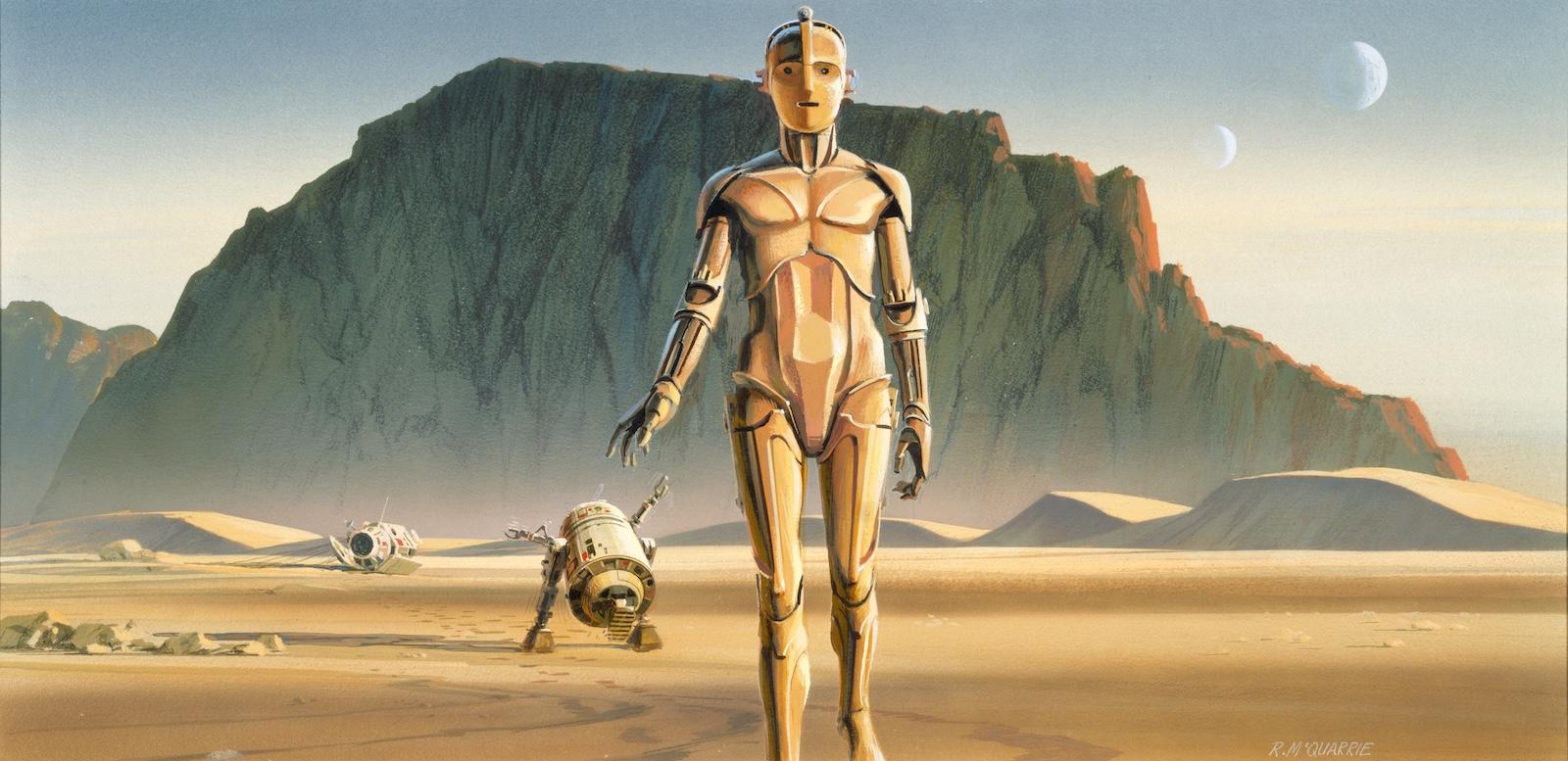
However, with the advent of photography in the middle of the 19th century, painting’s documentary role gradually faded, and artists began exploring other aspects of visual experience as they focused less on representation. “Art for art’s sake” and abstraction, among other aspects of Modernism, developed directly out of the shift away from narrative. But, that’s not to say that narrative went away. Far from it. In the 20th century, storytelling energy flowed into the new visual media of motion pictures, popular illustration, and comics. In these areas, unsurprisingly, the Lucas collection is especially rich. For example, among its holdings is a 1975 gouache on board by Lucasfilm concept artist Ralph McQuarrie, Artoo and Threepio Leave the Pod in the Desert, imagining a scene from Star Wars two years before it appeared on the screen.
Among the works of classic illustration art in the collection is an N.C. Wyeth oil on canvas made to accompany a story that ran in the Ladies’ Home Journal in 1926. In this image, two swashbuckling swordsmen in 17th-century garb duel on a beach against a background of heightened color, but to know the full meaning of the scene, one must read the story. On the other hand, in the comic-strip format, story and illustration are fully integrated, as in an ink-on- graphite Flash Gordon sequence from 1934 by Alex Raymond. The extreme density of image and text in the comics of that era reflects the increasingly frenetic pace of narrative in the 20th century.