

Over the years, Semmes has focused on these highly dramatic installations using velvet, chiffon, tulle, mohair, or flannel, but she has also explored and expressed her ideas in other areas, such as photography, ceramics, glass, painting, and finally performance. One might now think of her as a multimedia artist, since she has expanded her work and vision to define herself in this complex, multidisciplinary contemporary world, addressing highly diverse audiences.
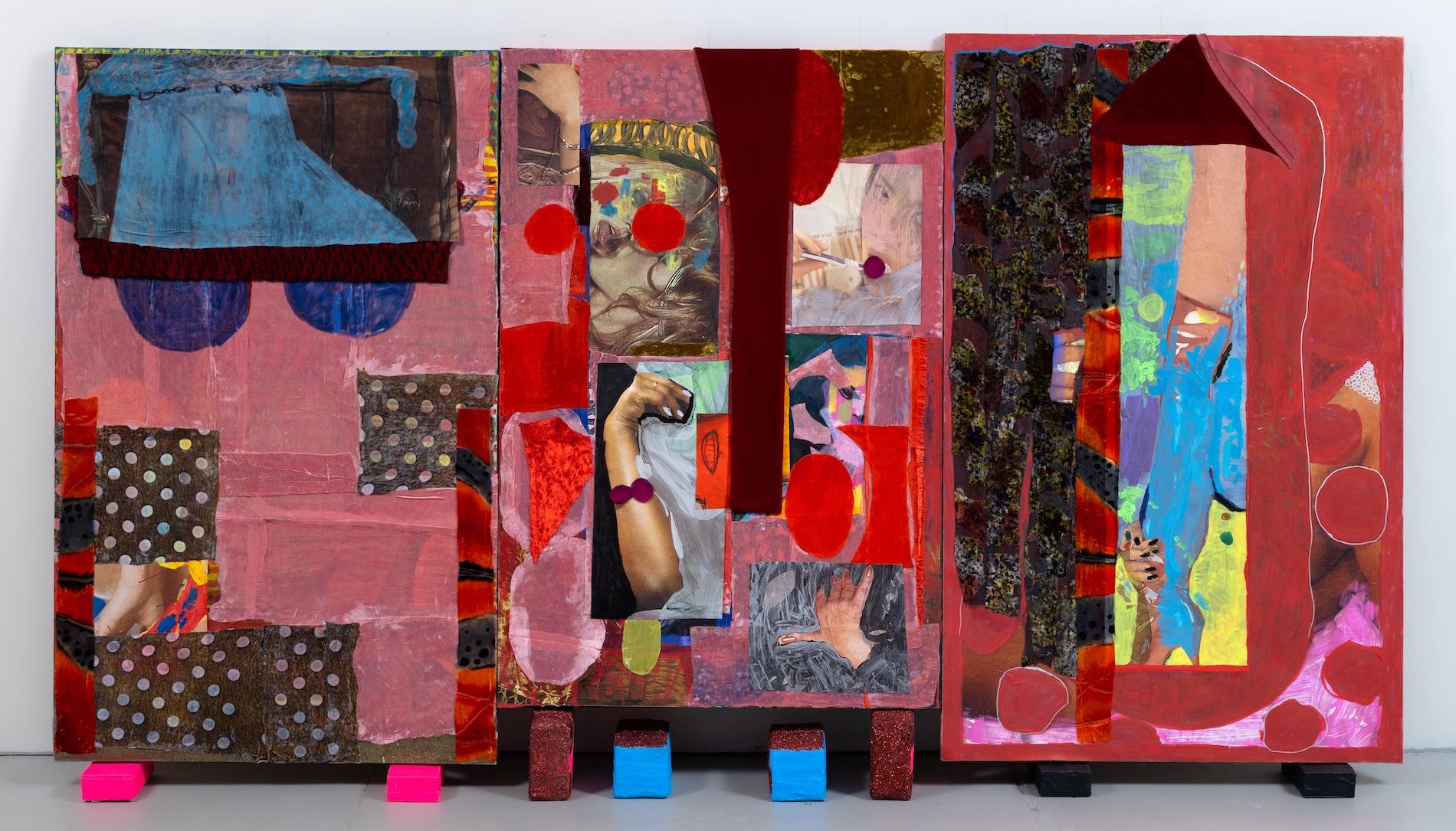
Courtesy of Susan Inglett Gallery, NYC
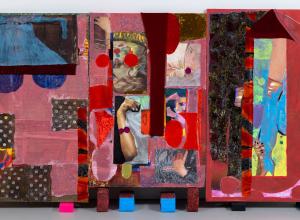
Beverly Semmes, Glitter Brick Triptych, 2023, Ink, acrylic, velvet, faux fur, printed canvas, polyester on printed canvas with tape, velvet, and glitter covered bricks
In the fall of 1991, a large, tall, and very dramatic four-part purple piece in Plastic Fantastic Lover (Object A), a group show of 21 women artists at the former Blum Helman warehouse in SoHo, captured the public’s attention. Writing in the New York Times, Roberta Smith observed, “Beverly Semmes's Four Purple Velvet Bathrobes, 12 feet high, suggest that you can never be too thin or too tall.” The piece immediately sold to the Denver Art Museum. Other large-scale installations like this came to be Blue Gowns (1993), now in the Rubell Museum, and Yellow Pool (1993), in the collection of the Nasher Sculpture Center. The work had traveled to museums in the United States—in Dallas and Kansas City—and then on to several European venues, thereby introducing Semmes to an international audience and opening the door to dealers in Germany and Italy.
About these early works, Semmes tells Art & Object, “Many of my sculptures from the 90s were designed to take up space. The viewer is pushed way to the side; you can’t really walk into the room.” Critic Patricia Phillips commented that Semmes’ garments “suggested impossibly huge, ungainly bodies, austerely evocative of long frustrations—a clothing of psychological and physical discomfort.” Despite the texture or character of the fabric used, they take over a space as an imposing presence. Such was the case with Six Silvers (1999), guarding the entrance to Microsoft’s conference center when it first opened to the public. Now, the work is in the collection of the Henry Art Gallery at the University of Washington in Seattle.
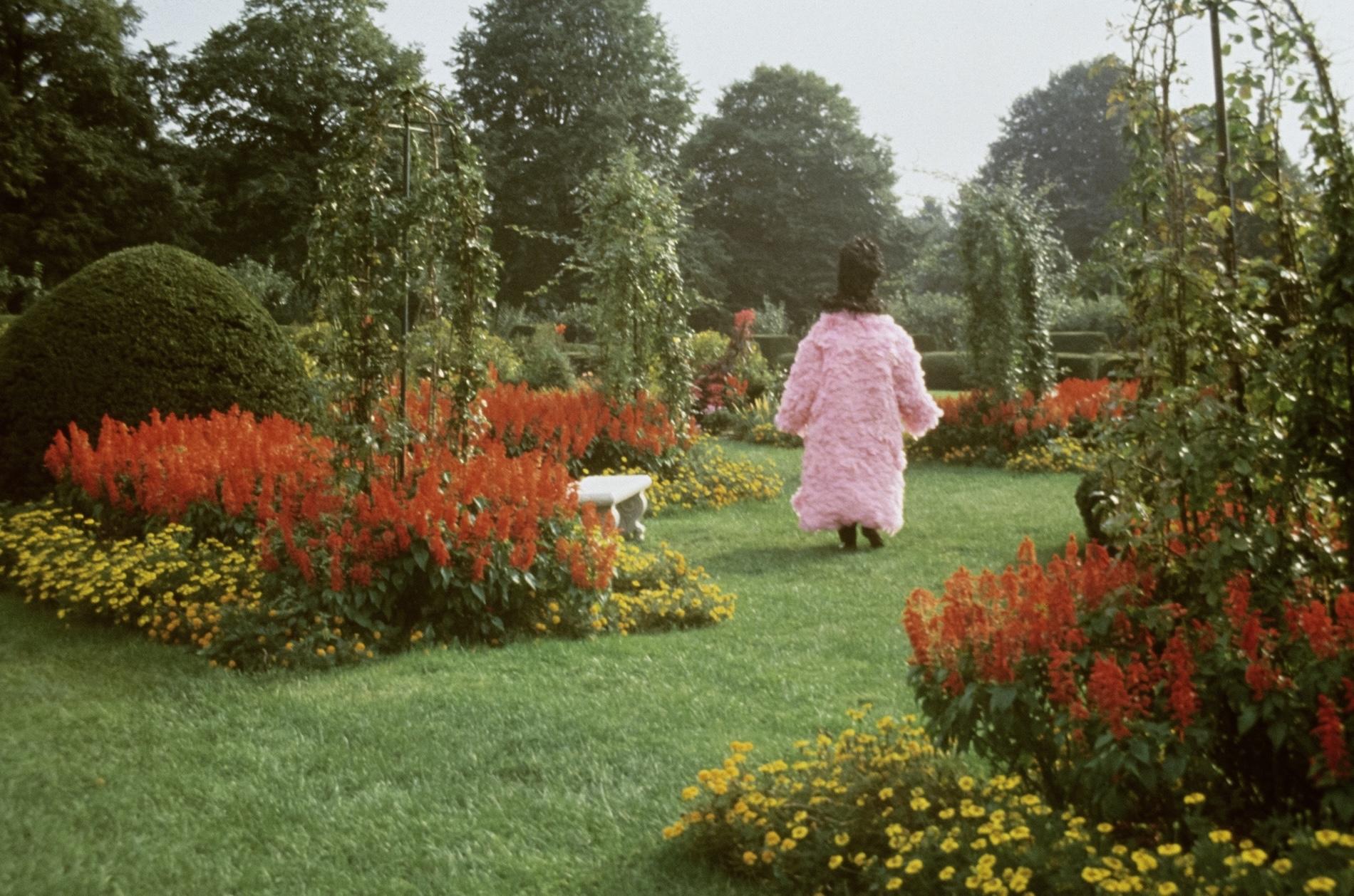
Copyright The Artist, Courtesy of Susan Inglett Gallery, NYC
Beverly Semmes, Cornelia Walking Through the Formal Garden in the Pink Feather Coat and Hedge Hat (View #1), 1988/2024, Digital print
This work has led Semmes to be invited to teach at New York University, Cornell University, and Pratt Institute in Brooklyn, where she taught an advanced figure drawing class, “a discipline,” Semmes explains, “that trains the eye and disciplines the student to draw something from three dimensions onto a two-dimensional paper.” Discipline is at the heart of Semmes’ art as she explores working in both ceramics and glass. She believes she is defying the traditions of both, making her vessels more tactile, exaggerating their form and shape to upset them as objects and transform them into enigmatic subjects.
Recently, in 2025, Tufts University in Boston organized a mini survey of Semmes’ career that included all of these mediums, which, as curator Dina Deitsch explained, “continue to explore issues of female visibility and presence.” Throughout the galleries were dress works, color photographs of models wearing Semmes’ cloth inventions, and two very recent, large collage paintings, allowing the viewer to explore the various aspects, ideas, and works that had evolved over some 30 years.
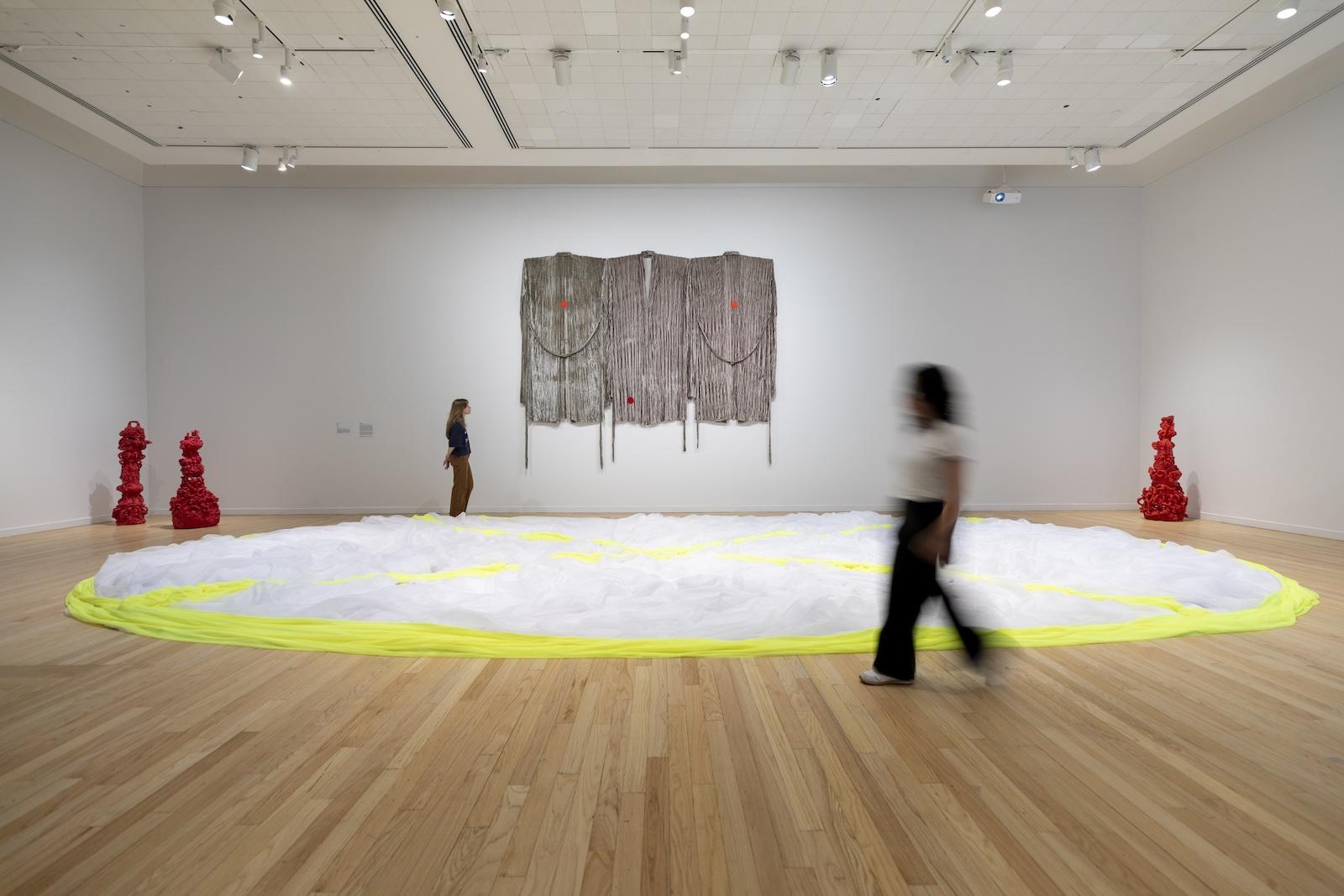
Photo: Mel Taing for TUAG, Courtesy of the artist and Susan Inglett Gallery, NYC.
Beverly Semmes, Installation view of Beverly Semmes: Boulders / Flag / Flip / Kick at Tufts University Art Galleries (29 July–23 November 2025)
One of the new works for the exhibition, Billboard, is composed of three monumental-scale robes made of crushed rayon velvet that measure over 10 feet in height and 13 feet in length. This trio of dark gowns is powerful, imposing, and provocative. As Semmes describes her idea, “The central robe faces towards the viewer, offering up a full frontal, while the two side robes show their backside in a retreat away from the viewer’s gaze. Instead of inviting someone to project themselves into the work—as is possible with my earlier fabric sculptures—I complicate and interrupt that possibility by partially installing this work turned away from the viewer, making it unclear whether the imagined figures behind the robes are present or absent, coming or going, past or future.”
Some 10 years earlier, in 2014, Ian Berry, Director of the Tang Teaching Museum, curated a solo show that included new works featuring gestural applications of ink and paint that concealed and revealed women’s bodies. The images were depictions of women photographed in pornographic magazines that Semmes found abandoned in her new studio at the Brooklyn Navy Yard, where she moved in 2008. These abstracted works on paper, later called the Feminist Responsibility Project, were exhibited with a video, beside a series of freestanding, eccentric-shaped ceramics and handmade glass chandeliers. The great variations of works in the show tell of Semmes’ own views on being a working woman and a distinguished female artist, and her interest in expanding and exploring multiple possibilities in her art while using diverse materials. This viewpoint also underscores her astute awareness of those issues on a daily basis, particularly in an art world where equality does not always exist.
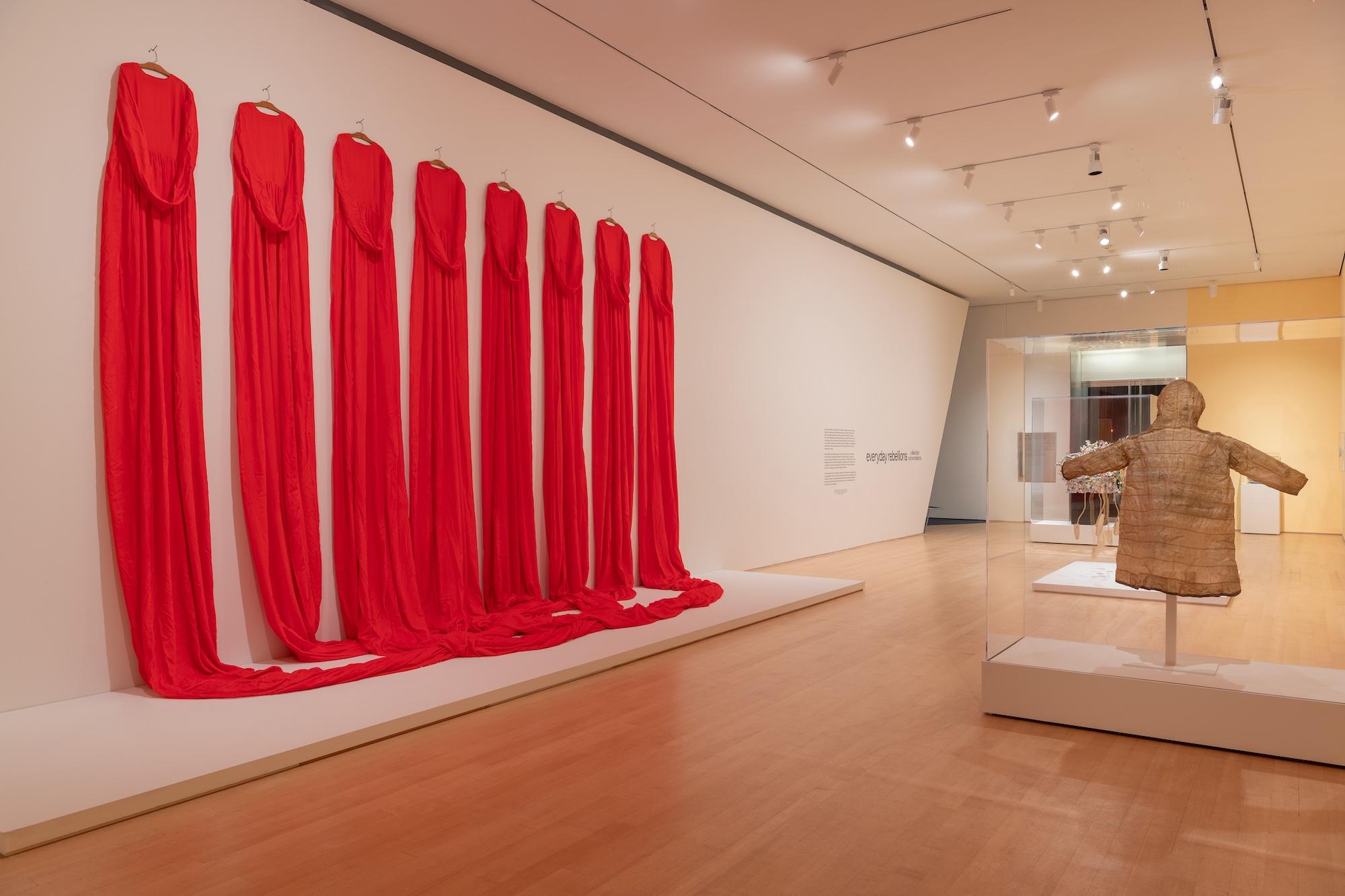
Photo: Paula Abreu Pita, Courtesy of the Brooklyn Museum, the artist, and Susan Inglett Gallery, NYC.
Beverly Semmes, Installation view, Everyday Rebellions: Collection Conversations, Brooklyn Museum (10 October 2025—5 July 2026)
Another aspect of her work with clothing is the CarWash Collective. These designed garments, as Semmes explains, “extend the language of the Feminist Responsibility Project.” She continues, “The CarWash Collective developed fashion garments for performances. I made the works in collaboration with the fashion designer and educator Jennifer Minniti.” About this collaboration, Minniti has written, “Most serious work comes out of the tension formed when working alongside someone else. CarWash Collective is the clearest instance of this instinct…The truth is that the project is a forced acceptance of the fact that meaning in the work is arrived at between us rather than issued by either one of us as singular makers. It is precisely the conflict between our instincts that stretches the work into something that neither of us could resolve alone.” Semmes adds, “These garments are composed of fabrics featuring my collages from the Feminist Responsibility Project.” Another kind of garment is achieved, but again, as the larger installation works together, they address the issue of femininity.
Next year, Semmes will present for a new gallery in Los Angeles, Official Welcome. This show follows her last at the gallery, entitled Body Shop, which included several new works that combined large, but not giant, soft bodices in faux fur, velvet, and other materials with pairs of slippers ranging from Versace driving moccasins and Gucci fur-lined horsebit scuffs to Ugg brand and generic fuzzy slippers. Each is a small tableau of the feminine, a trademark of Semmes’ ideas.