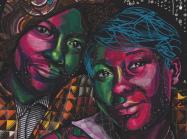

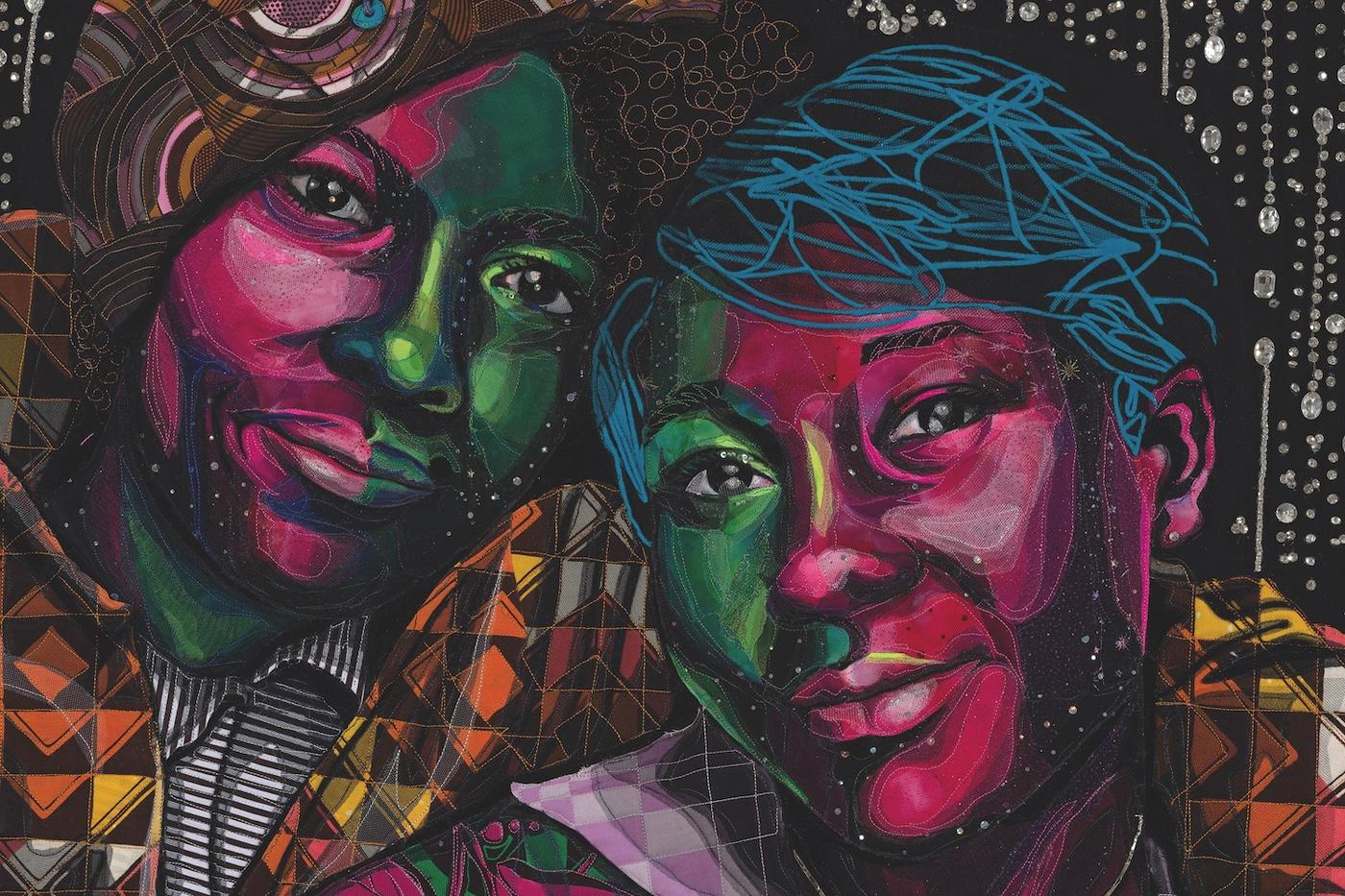
“They say that black is not a color. So this is a repudiation,” says Butler, whose works might include 15 layers of fabric. “In every piece, I’m using black as a base, adding more layers than usual, using sparkly things and glitter to make the black shine through.”
In Nigeria’s Yoruba culture, red is the color of Chango, a powerful deity. Butler uses the color to depict power as in The Guardian, a portrait of a man in green leopard-skin faux fur, holding his head-scarfed daughter close, her face framed by the opening of his jacket. Above him flies the Stars and Stripes in the David Hammons colors of red, green, and black. The image is sourced from a photo (as is all her work), taken in 1990 by Earlie Hudnall, Jr. Once Butler settles on an image, she contacts the photographer and opens negotiations. Often the cost is no more than a nominal fee, though some ask for a print of the completed work.
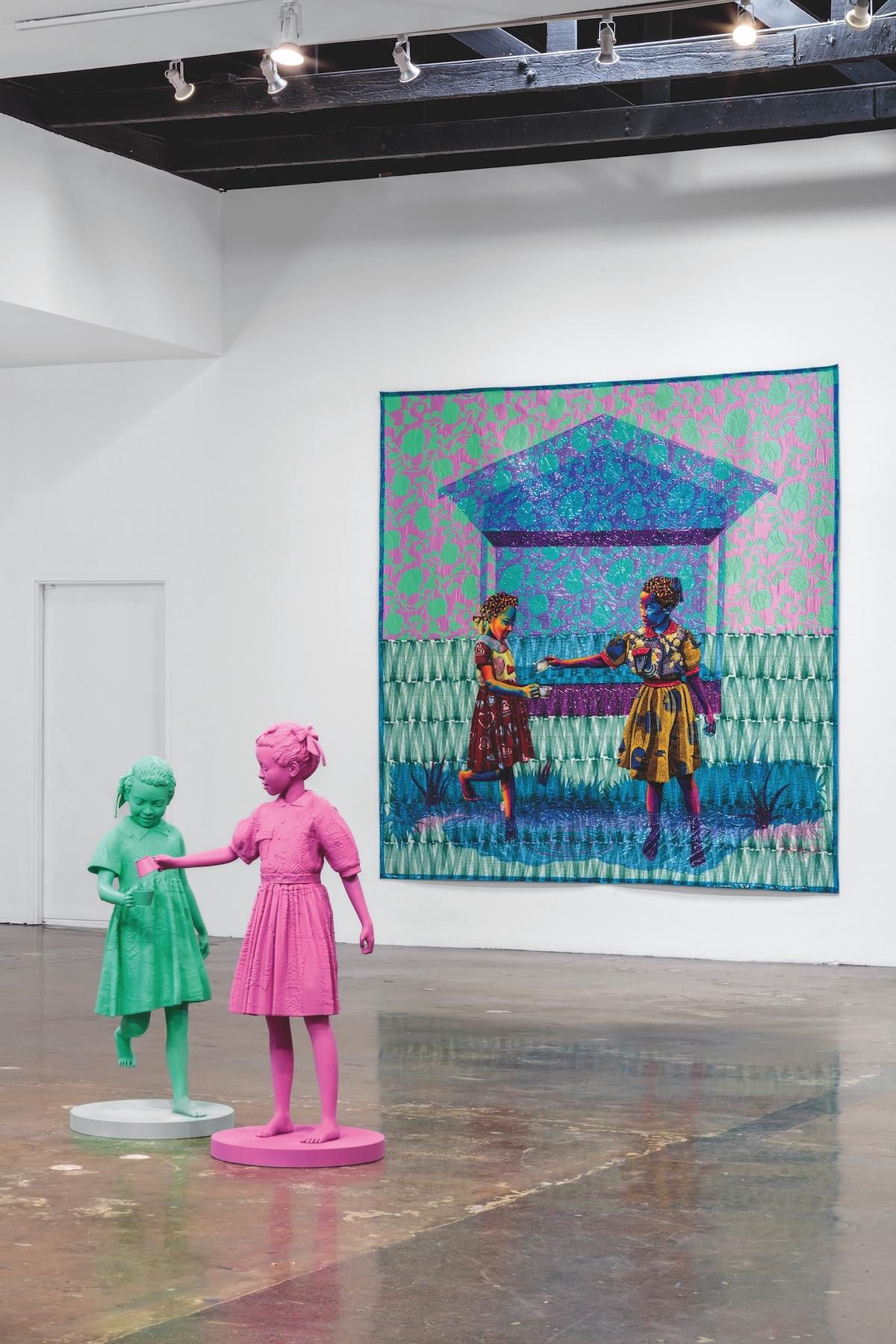
Down, down, baby depicts two little girls playing in a ditch in front of a shotgun shack. One holds a teacup of water, which she pours into the waiting cup in the other girl’s hand. It’s based on a photograph by the great Gordon Parks, taken in Alabama for his 1956 LIFE magazine assignment, The Restraints: Open and Hidden, about life under Jim Crow. The original, titled Girls Playing in Water, has the girls standing in black, brackish water, indicating no indoor plumbing as well as risks of disease and infection. But in Butler’s rendition, the water is limpid blue, and the background is a knockoff of a pale green and lavender-pink pattern. These are colors that remind her of her children.
For Butler, quilting and sewing hold a special place in her family. Her grandmother would accompany her husband—the U.S. Emissary to Morocco in the 1950s—to state affairs in her homemade Christian Dior. Years later, Butler’s mother and aunt used to sit and sew together. It’s one reason why Butler doesn’t use a lot of quilting material, opting instead for scraps from her mom—various fabrics, tulle, or lace as components in her works.
At Howard University, Butler pursued a degree in painting, but then got pregnant and became violently nauseated by the smell of oil paint. “I was struggling in painting,” she says. “I can paint very well and realistically, but I have to draw what I see. So all my paintings were hyper-realistic, and that’s not what I wanted.”
So she stopped painting. One of her professors suggested collage and introduced her to the work of Romare Bearden. It was a course correction that eventually led to a vital and lucrative career. As a mom and struggling artist, she worked as a high school art teacher in Newark, New Jersey.
“My stuff was for me. And, all the people around me liked my artwork, so the validation was coming,” she recalls of the salad days. “One of the teachers asked me to do a portrait of her and her daughter, and she framed it. And her husband took me out to dinner.”
She finds inspiration from artists of all stripes, but relates most to artists of color. “I want to know how they survived in that era,” she says. “If I’m going to make it as a Black woman artist, I can’t look at Mary Cassatt. I can relate to Frida Kahlo, because she fought for equal rights as a woman artist and was really determined to bring in her Indigenous culture. I’m not trying to paint like Frida, but I want to know how to live a life with dignity and how to live as an activist artist.”