Studio  April 14, 2026  Barbara A. MacAdam

Annette Hur’s Landscape Paintings Speak a Language of Color

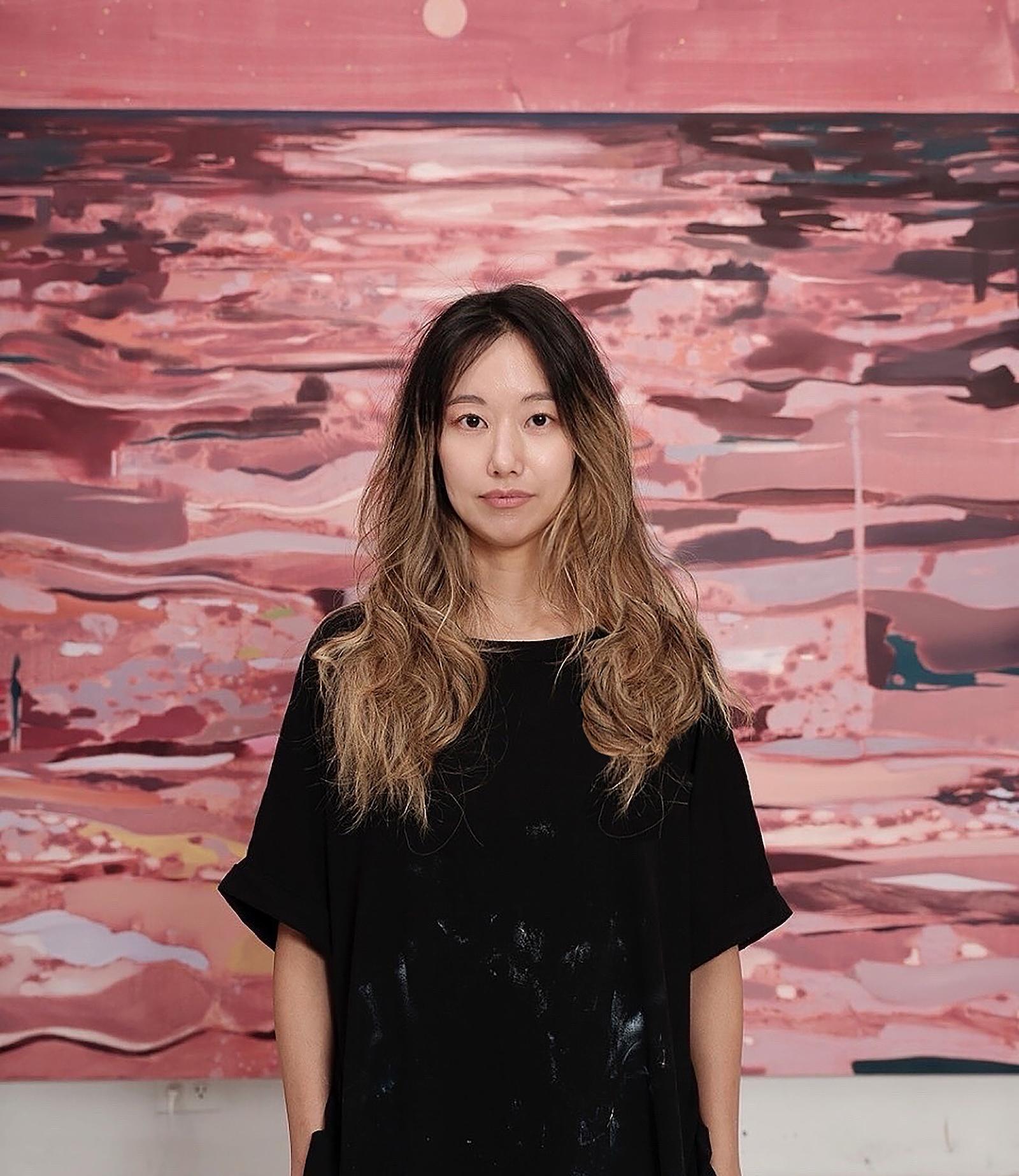
COURTESY OF THE ARTIST AND CHART GALLERY, NEW YORK. PHOTO BY ADAM REICH

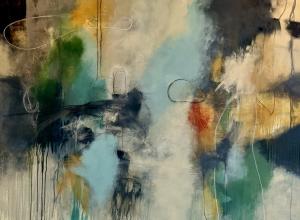
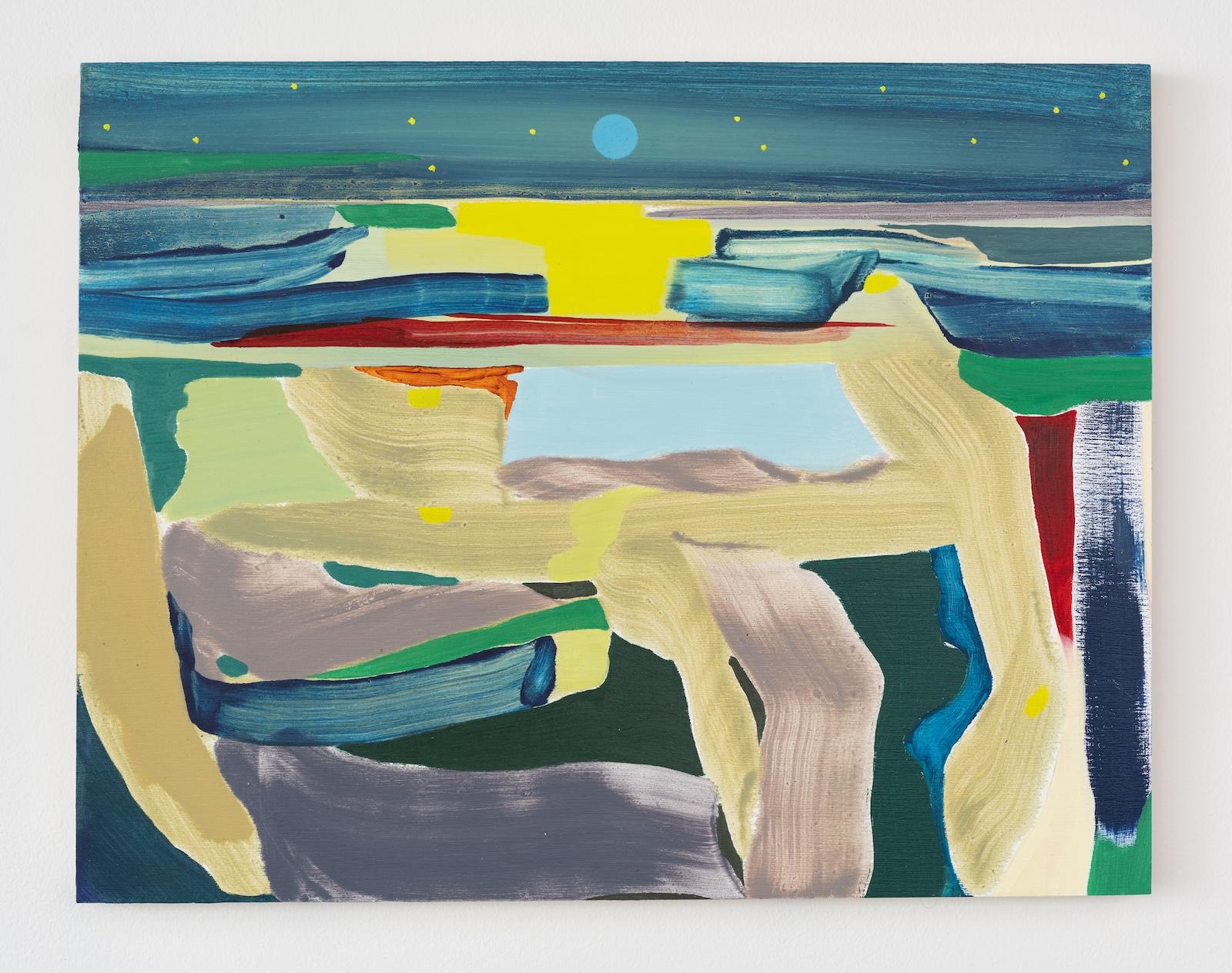
Annette Hur, Horizon Study 2, 2025.

Riding the waves of history and biography, Annette Hur gives shape to passion, disillusion, longing, fear, and self-realization. Bridging her native South Korea and her adopted hometown of New York, she has embarked on a watery route from shore to shore, holding the extremities apart and in place, secured by an unbreakable psychological magnetism and the gravitational pull of the moon.

As I enter her studio in Red Hook, Brooklyn, via Zoom, Hur spontaneously launches into her unsettling biography, revealing how she chose to escape to the U.S. in 2013 and began her sojourn at the University of Chicago, where she studied with the portrait and landscape painter Susanna Coffey before moving on to Columbia University and working with Gregory Amenhoff, an abstract painter whom she refers to as her mentor. Now an adjunct professor at Columbia University School of the Arts, Hur is happily settled in New York, having exhibited at such galleries as Hesse Flatow and Gavin Brown, among others. She is currently represented by Chart Gallery in TriBeCa.

We quickly sense that Hur, who communicates predominantly via landscape, writes her story on the richly colored canvases, both large and intimate, which line the studio walls. Animating and commandeering the workspace are two furry brown and white dogs (one, her own; the other, her five-year-old son’s) caught frolicking across the waves of paint in her orderly yet informal studio. The activity of that interior landscape mirrors the complexity of Hur’s biographical and physical journey across sea and cultures. At 41, she appears younger than her age and is surprisingly forthright as she speaks of her life. She is angry—with a South Korean society that suppresses women and is so conservative that she had to run from it and from an abusive marriage. We see evidence of it in the intensity of her colors and her insistent brushstrokes. Color is most important to her. “I like to explore new colors; I like nontraditional colors,” she says. For her, she explains, “color is movement—light is speed.” She uses oil paints, which in their richness and depth, she says, “have no limits.”

COURTESY OF THE ARTIST AND CHART GALLERY, NEW YORK. PHOTO: ADAM REICH

Annette Hur

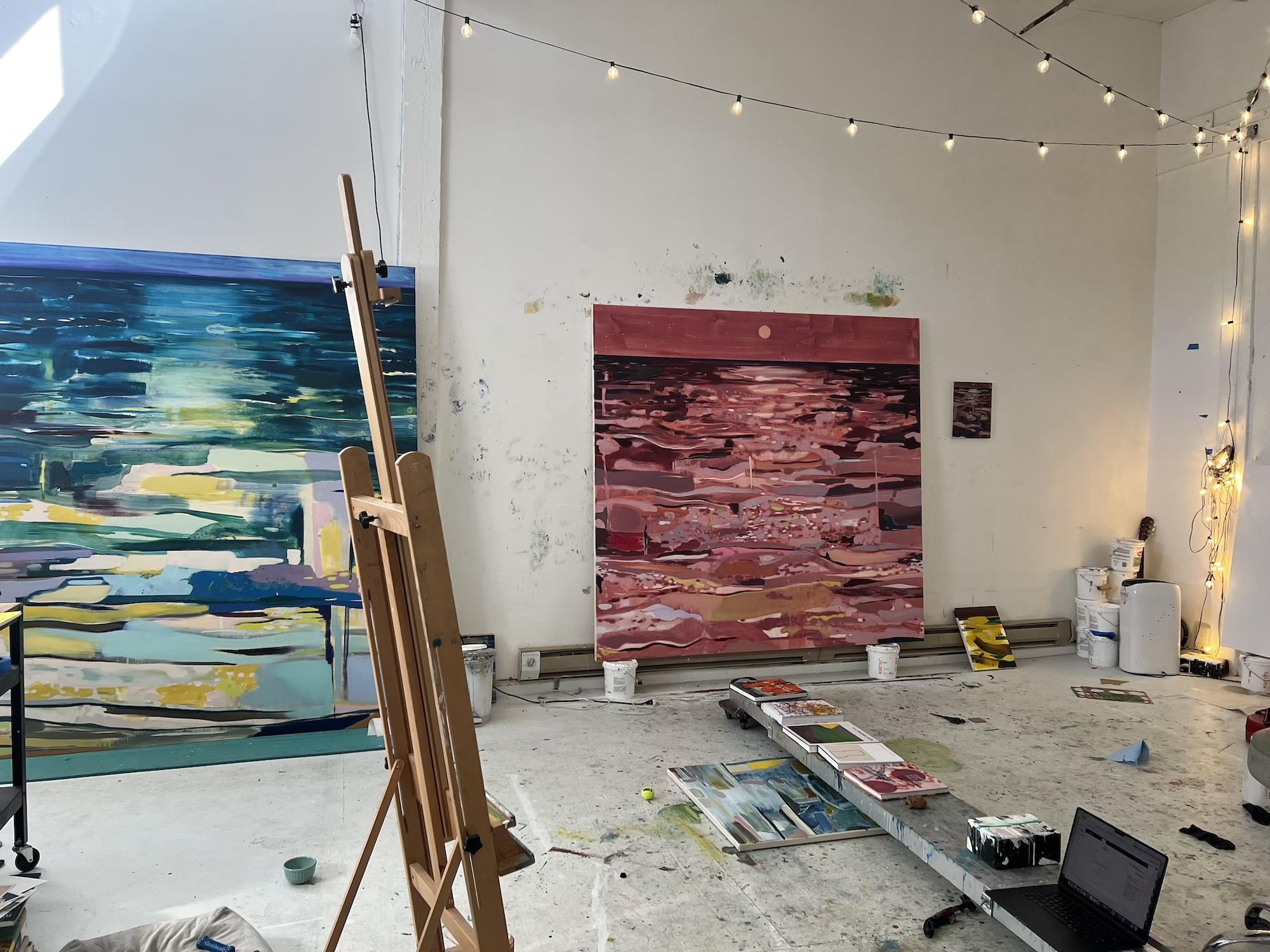
“My initial idea was to paint a body of water with horizon lines,” she explains, as we circumnavigate the room, beginning with two large warm-toned paintings. She establishes emotional and physical distance in these works, punctuated by undefined abstract white body shapes, like ghosts. She explains how she uses the moon, positioned at the top of the canvas, as a light source, as it produces a warmer and less direct effect than the sun and requires more concentrated observation for the viewer. It also is a rich font of symbolic meaning—associated with the passage of time and tides and with feminine life cycles. At the same time, Hur points out that she has played with using reflection from the water as another source of light, as in the waterfalls that flow throughout her paintings and appear like moving bodies that spread illumination and conjure memories. 

A series of small paintings is assembled in the gallery, appearing like excerpts from the larger ones, which Hur notes “are in a completely different language from the bigger ones,” softer and more gestural. She sees them not as studies for the larger works, but as “painting objects, not sculptures,” and she creates these objects by “editing out the extras” from the larger images.

Hur mixes her own colors, and when she is doing it, she says, she is thinking in her native language: “You can speak the colors in Korean.” She gets all of her brushes from Korea and uses three widths. She likes them because they tend to be softer, and the paint flows better for smoother application, “I always want to surprise myself,” she says. “I care more about color than composition,” and adds that Korean colors tend to be “complicated, in a good way,” They tend to be more nuanced, “like the nuances of language.” For example, the blue produced in Korea, which is used a lot, is a warmer tone, “a saturated, fresh blue.” There’s a novelistic quality to her paintings with varying passages—a shift into a dark denseness, for example, in the painting Till the Day Being Loved. It is as if the work were divided into chapters, with each section conveying a different mood.

Hur uses a lot of pink, mixing sweetness in contrast to the depths of forest darkness. And she  guides the viewer’s eye with streaks and bars of white. Contrasting soft and linear passages, she adds an unexpected complexity to the paintings, alluding to traditional Asian landscapes with their sense of motion and, simultaneously, of solidity.

To build her paintings, she puts her canvases down on the floor and sets a kind of concrete platform over them, which she can roll back and forth, spanning the works so she can follow her progress, viewing them from above and below, mimicking the course of the waves in her paintings and her thoughts.
COURTESY OF THE ARTIST AND CHART GALLERY, NEW YORK. PHOTO: ADAM REICH

Inside Annette Hur’s Brooklyn studio.

The platform also holds a number of art books that inspire Hur. There’s a volume devoted to Peter Doig, whose gently dipped brushmarks generate both motion and a sense of domestic interior in the manner of Vuillard and Bonnard. His night scenes are at once mysterious and dynamic, not unlike Hur’s. Accompanying Doig on the platform are volumes devoted to Cecily Brown and Joan Mitchell. Hur is also inspired by the psychological feminist sculptor Louise Bourgeois, the late Korean geometric Modernist painter Yoo Young Guk, the traditional landscape painters of the Chosun Dynasty in Korea, and Korean folk artists such as the Kum Kang Mountain painters.

Passing though the studio, there is a small flight of stairs, installed by Hur, leading to a balcony area that holds a table and a simple Singer sewing machine, along with a swatch book of silk fabric color samples. We might take it as an allusion to the factory work of women in Korea, alone and toiling. Against the horizontals of the waves, the verticals of the waterfalls are marked by an abstracted, white non-human body. Vertical white lines interspersed like placers throughout the paintings guide us through the terrain and add stability.

“At some point, I started seeing myself as a part of the landscape, not a protagonist,” Hur says. “In this recent body of work, I am not concerned about looking but rather discovering and navigating the structure and psychological, metaphorical existence as a part of nature, mostly as a body of water that is boundless and undefined in forms.”

Hur touches on the broad spectrum of the art of our times, distilling the world around her into abstraction, portraying and investigating nature, blending concretely material forms with more ethereal kinds of expression. She does all this as an immigrant longing for security and certainty, and as a woman yearning to be comfortable with her identity and career, a speaker of numerous languages and an artist born of many styles.

*This article originally appeared in Art & Object Magazine's Summer 2025 issue.

About the Author

Barbara A. MacAdam

Barbara A. MacAdam is a New York-based freelance editor and writer, who worked at ARTnews for many years as well as for Art and Auction, New York Magazine, Review Magazine, and Latin American Literature and Arts. She currently reviews regularly for The Brooklyn Rail.

Subscribe to our free e-letter!

Webform
Art and Object Marketplace - A Curated Art Marketplace