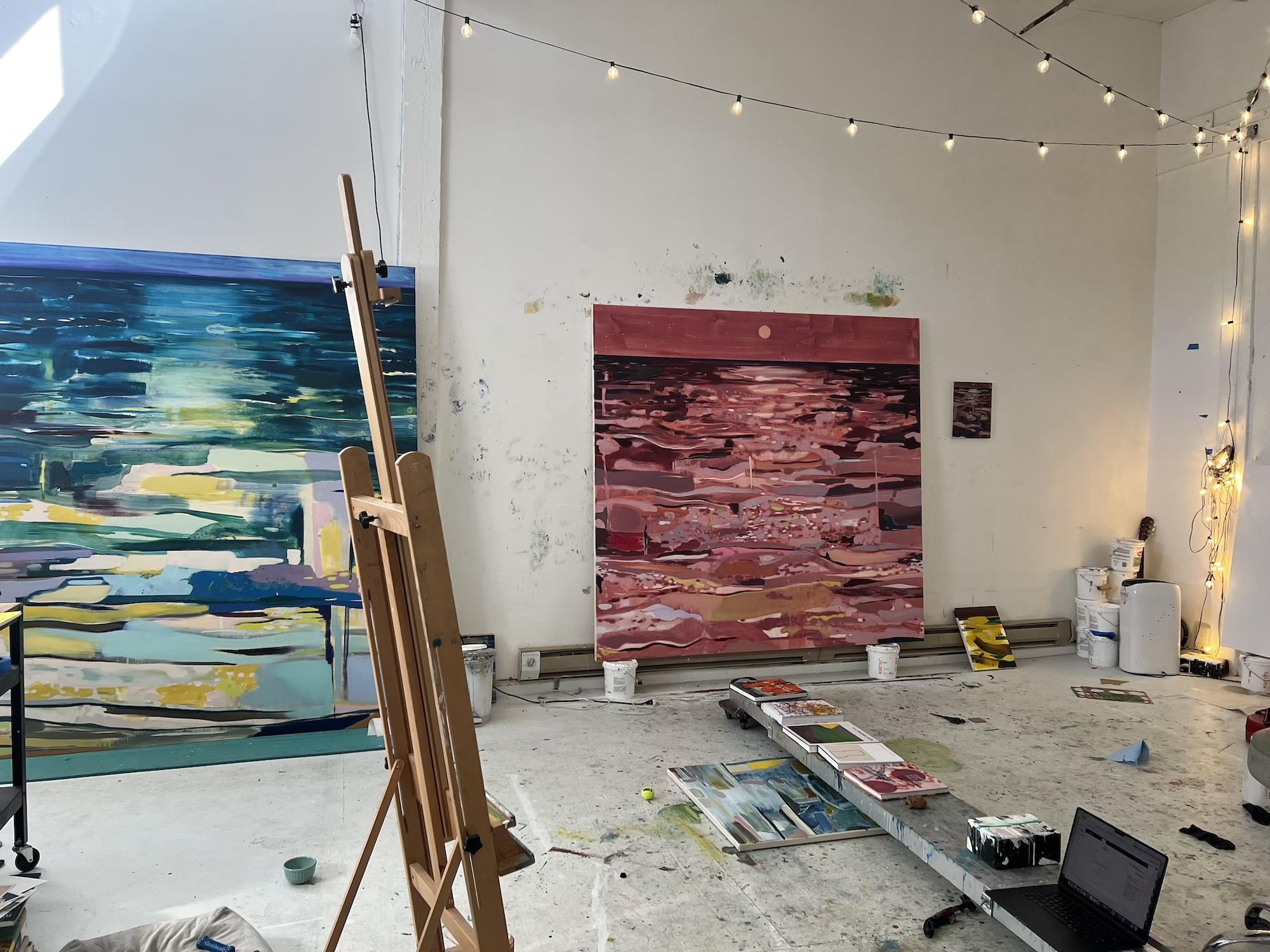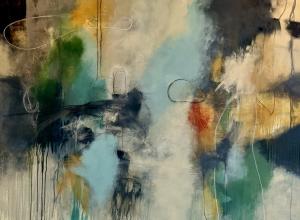
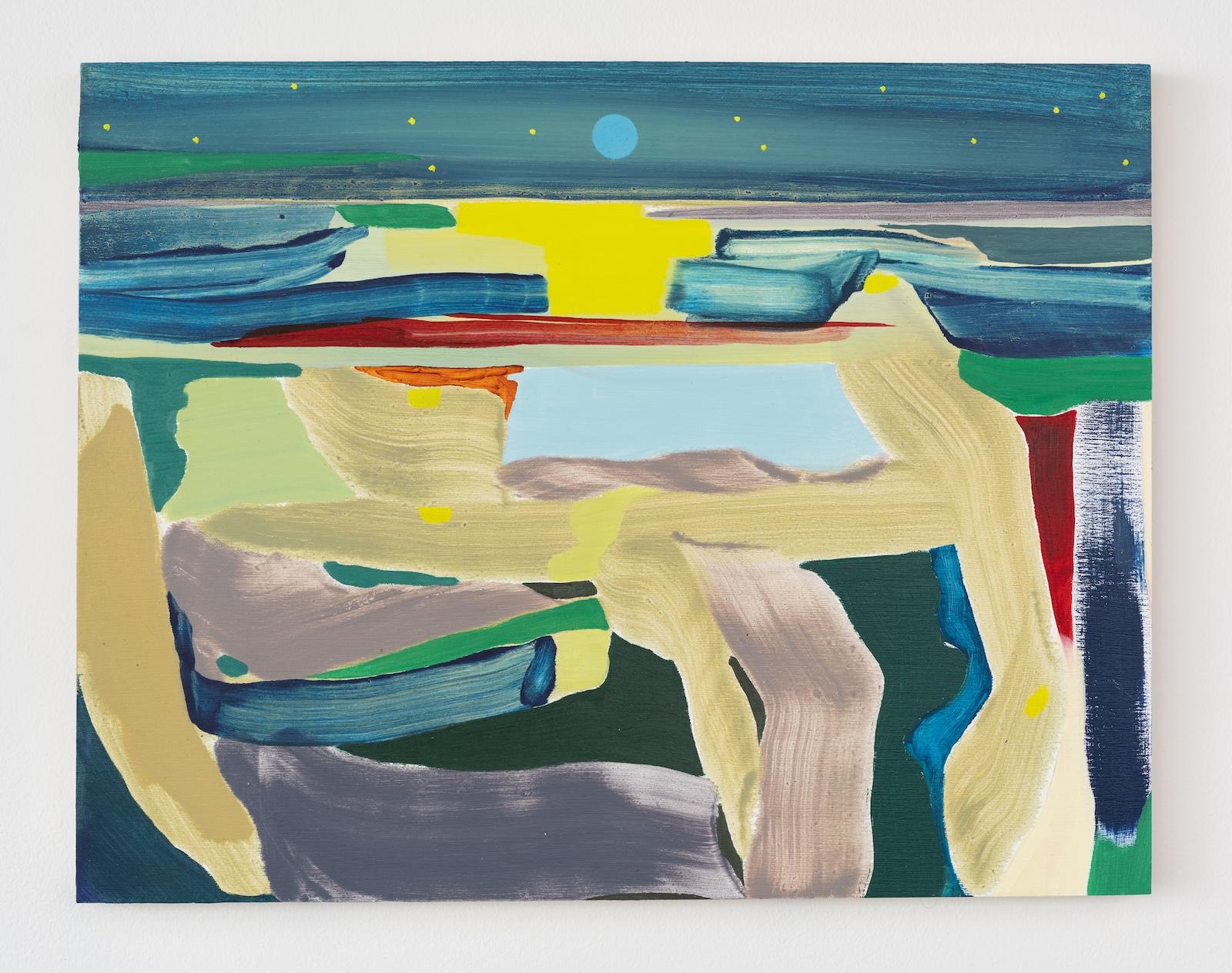
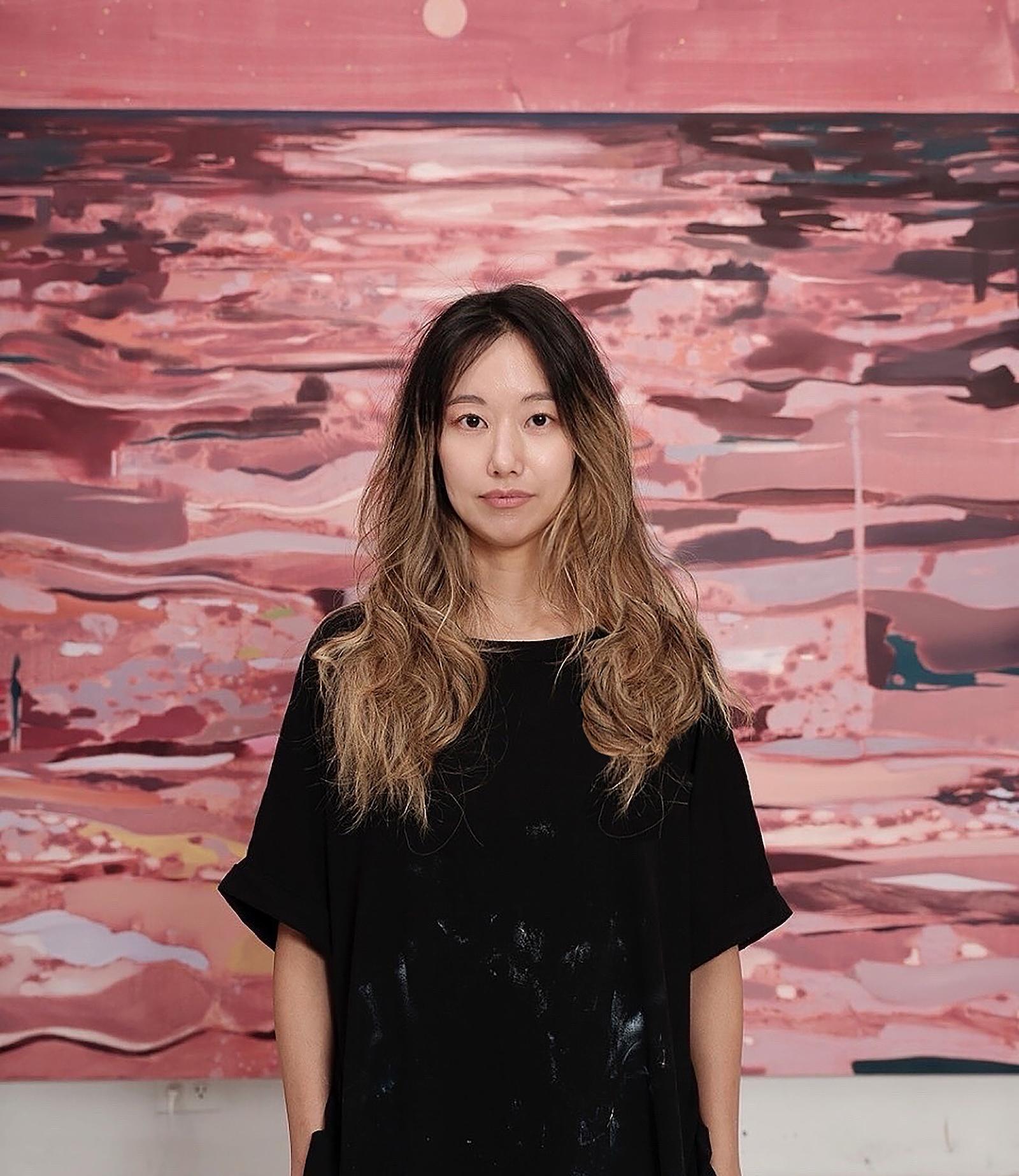
“My initial idea was to paint a body of water with horizon lines,” she explains, as we circumnavigate the room, beginning with two large warm-toned paintings. She establishes emotional and physical distance in these works, punctuated by undefined abstract white body shapes, like ghosts. She explains how she uses the moon, positioned at the top of the canvas, as a light source, as it produces a warmer and less direct effect than the sun and requires more concentrated observation for the viewer. It also is a rich font of symbolic meaning—associated with the passage of time and tides and with feminine life cycles. At the same time, Hur points out that she has played with using reflection from the water as another source of light, as in the waterfalls that flow throughout her paintings and appear like moving bodies that spread illumination and conjure memories.
A series of small paintings is assembled in the gallery, appearing like excerpts from the larger ones, which Hur notes “are in a completely different language from the bigger ones,” softer and more gestural. She sees them not as studies for the larger works, but as “painting objects, not sculptures,” and she creates these objects by “editing out the extras” from the larger images.
Hur mixes her own colors, and when she is doing it, she says, she is thinking in her native language: “You can speak the colors in Korean.” She gets all of her brushes from Korea and uses three widths. She likes them because they tend to be softer, and the paint flows better for smoother application, “I always want to surprise myself,” she says. “I care more about color than composition,” and adds that Korean colors tend to be “complicated, in a good way,” They tend to be more nuanced, “like the nuances of language.” For example, the blue produced in Korea, which is used a lot, is a warmer tone, “a saturated, fresh blue.” There’s a novelistic quality to her paintings with varying passages—a shift into a dark denseness, for example, in the painting Till the Day Being Loved. It is as if the work were divided into chapters, with each section conveying a different mood.
Hur uses a lot of pink, mixing sweetness in contrast to the depths of forest darkness. And she guides the viewer’s eye with streaks and bars of white. Contrasting soft and linear passages, she adds an unexpected complexity to the paintings, alluding to traditional Asian landscapes with their sense of motion and, simultaneously, of solidity.
To build her paintings, she puts her canvases down on the floor and sets a kind of concrete platform over them, which she can roll back and forth, spanning the works so she can follow her progress, viewing them from above and below, mimicking the course of the waves in her paintings and her thoughts.